Last Updated: November 14, 2026
Quick Summary
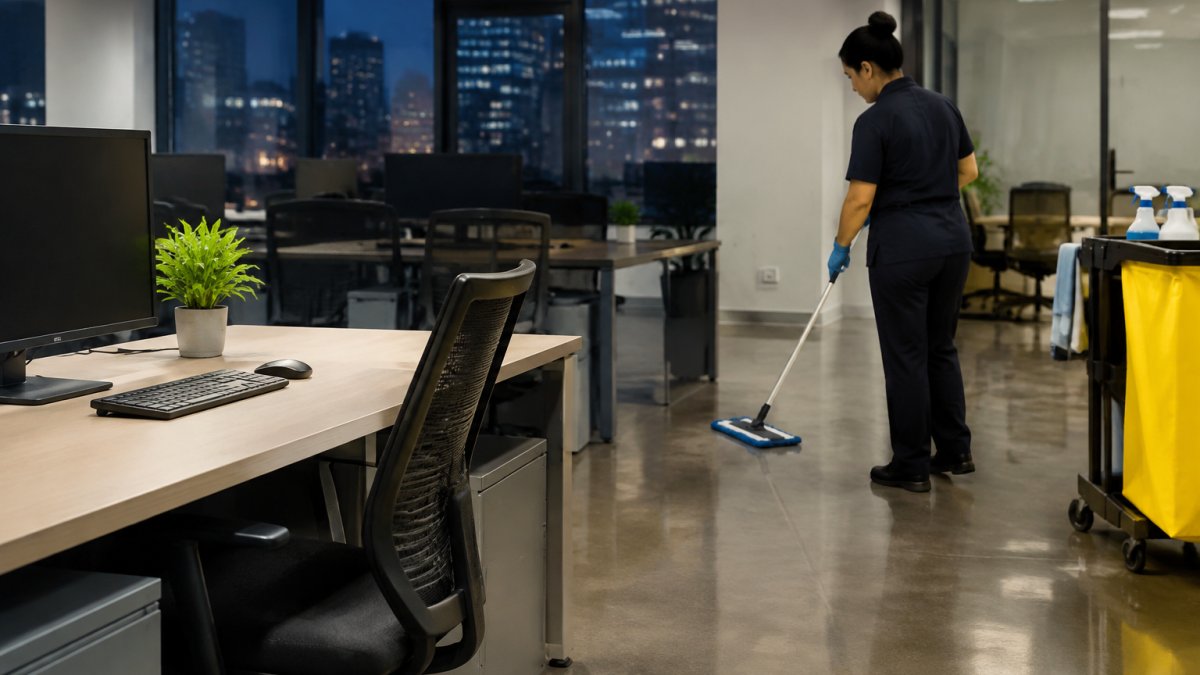
After hours office cleaning is a scheduled professional cleaning service performed outside normal business hours, typically in the evening or overnight, so the workspace is ready before employees arrive. Its main benefits are zero disruption to calls, meetings, and client visits, full access to desks and shared spaces for thorough work, practical deep cleaning and floor care, and a space that is presentation-ready every morning.
- Cleaning removes soil and dust, while disinfecting kills germs on surfaces that have already been cleaned.
- Night cleaning lets restrooms and kitchens be fully scrubbed and restocked without interrupting employees.
- After-hours service requires a documented key, alarm, or access-control process before the first visit.
- Ask each provider to price the same written scope for both a daytime and an after-hours schedule.
- Run a two- to four-week trial with a joint inspection at the end to surface scope gaps.
Table of Contents
- Why After Hours Office Cleaning Benefits Your Business
- Reduced Workplace Disruption and Better Employee Focus
- Healthier Workplaces Through Sanitizing and Germ Reduction
- Cleaner Restrooms, Kitchens, and Shared Spaces
- Better Client First Impressions and Employee Retention
- Daytime vs. Nighttime Office Cleaning: A Comparison
- What an Office Cleaning Checklist Should Cover
- Office Cleaning Frequency and Professional Cost Per Month
- Security, Access Control, and Confidentiality
- How to Evaluate After Hours Office Cleaning Providers
- Frequently Asked Questions
Why After Hours Office Cleaning Benefits Your Business
After hours office cleaning is a scheduled professional cleaning service performed outside normal business hours, typically in the evening or overnight, so the workspace is ready before employees arrive. For most offices, it removes the single biggest objection to professional cleaning: the disruption. This guide covers what those benefits look like in practice, plus the trade-offs, checklists, and provider questions that decide whether the arrangement works.
Here's the core argument: cleaning is not a chore you schedule, it is an operating decision. When you move it outside the workday, you change who is affected, what can be cleaned thoroughly, and how your space looks to the people who matter. Below, we break down each benefit, the honest drawbacks, and how to evaluate a provider before you sign.
Reduced Workplace Disruption and Better Employee Focus
The biggest mistake with daytime cleaning is treating it as neutral. It isn't. A vacuum running next to a conference call is a cost, just an invisible one.
After-hours service avoids daytime interruptions. Your team arrives to a finished space, not a work in progress. No cords across the floor, no chemical smell in the break room at 10 a.m., no asking a client to step around a wet floor sign.
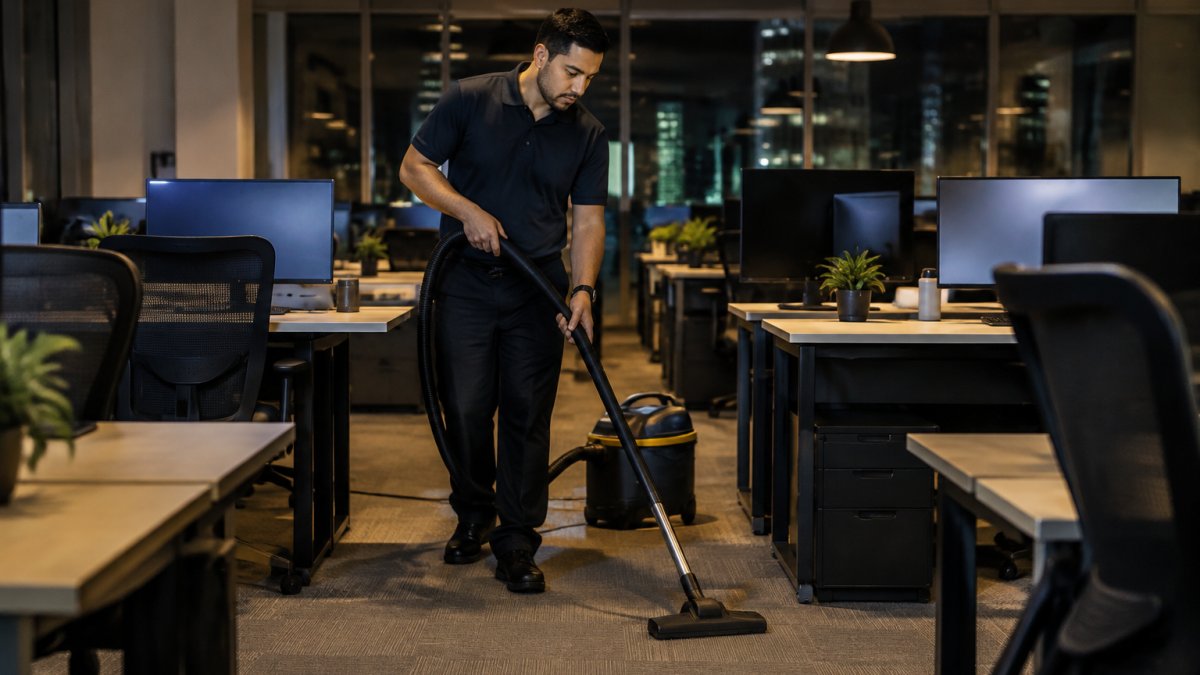
What most guides miss is the compounding effect. Interrupted focus doesn't just cost the five minutes of noise. It costs the twenty minutes it takes to get back into deep work. Multiply that across a team and a full year, and the disruption is the real expense, not the invoice.
Healthier Workplaces Through Sanitizing and Germ Reduction
Shared surfaces are where offices get people sick. Door handles, keyboard trays, microwave buttons, copier touchscreens, and conference room tables collect germs all day and rarely get touched by anyone with a disinfectant.
After-hours service makes sanitizing practical because there is time to do it properly. A crew working in an empty office can disinfect high-touch points without waiting for people to move, and without leaving residue on surfaces employees are about to use.
A common approach is to separate cleaning from disinfecting. Cleaning removes soil and dust; disinfecting kills germs on surfaces that have already been cleaned (the CDC). Skipping the first step weakens the second.
Fewer sick days are one payoff some offices notice. The CDC guidance on cleaning and disinfecting workplaces is a useful reference for which surfaces deserve daily attention.
Cleaner Restrooms, Kitchens, and Shared Spaces
Restrooms, break rooms, and kitchens are the areas employees judge a cleaning service by, and they are the hardest to service while people are using them.
Night cleaning solves the access problem. Restrooms can be fully scrubbed, floors mopped, dispensers restocked, and trash removed without a single awkward interruption. Kitchens get the same treatment: appliance exteriors wiped, sinks scrubbed, counters cleared, and floors mopped after the last coffee is poured.
Deep cleaning is easier to schedule outside business hours, when nobody needs to walk on freshly treated areas for a few hours.
Watch out: if your provider treats restrooms and break rooms as a quick wipe rather than a documented task, the difference shows up within a week. Ask to see the checklist line items for these areas before you sign.
Better Client First Impressions and Employee Retention
Clients form an opinion of your business before anyone speaks. A reception area with a scuffed floor and a coffee-stained table sets a tone no amount of good service fully undoes.
After-hours service means the space is always at its best during the hours clients actually see it. That is the entire point of the model: presentation is guaranteed at the moment it matters, not whenever the crew happens to finish.
There is a second audience most offices underestimate. Employees notice cleanliness, and they read it as a signal about how the business is run. A workplace that is consistently maintained feels cared for, and that perception feeds retention. The SHRM research on workplace culture and retention consistently ties environment and management consistency to whether people stay.
Daytime vs. Nighttime Office Cleaning: A Comparison
Daytime and nighttime cleaning differ mainly in who gets disrupted and what can be cleaned thoroughly. Daytime service keeps a crew on site during business hours, which suits light touch-ups and rapid response; after-hours service trades that visibility for uninterrupted, more thorough work.
| Factor | Daytime Cleaning | After-Hours Cleaning |
|---|---|---|
| Employee disruption | High, ongoing during work | None during business hours |
| Access to workstations | Limited by occupants | Full access to all areas |
| Deep cleaning feasibility | Difficult to schedule | Straightforward |
| Security and access | Staff present to monitor | Requires key or alarm protocol |
| Energy and HVAC use | Runs during occupied hours | Often during unoccupied hours |
| Best for | Light touch-ups, high-traffic lobbies | Full-service office programs |
Pros and Cons of After-Hours Services
Pros
- Zero disruption to calls, meetings, and client visits
- Full access to desks, floors, and shared spaces for thorough work
- Deep cleaning and floor care become practical
- Space is presentation-ready every morning
Cons
- Requires a documented key, alarm, or access-control process
- Fewer staff on site to catch problems in real time
- Quality depends heavily on the provider's checklist and supervision
- Scheduling changes need more lead time
The trade-offs are real, but they are manageable. The access question is the one that decides whether after-hours service works for you.
What an Office Cleaning Checklist Should Cover
A strong checklist is specific, room-by-room, and written down. Vague scopes like "general cleaning" are where missed tasks hide. Here is what a professional scope should include.
Daily and per-visit tasks
- Vacuum all carpeted areas and entry mats
- Dust desks, sills, ledges, and horizontal surfaces
- Empty and reline all waste and recycling bins
- Spot-clean glass doors and entry partitions
- Disinfect high-touch points: handles, switches, shared keyboards, copier panels
- Clean and restock restrooms, including dispensers and mirrors
- Wipe and sanitize break room counters, sinks, and appliance exteriors
- Mop hard floors in restrooms, kitchens, and lobbies
Scheduled tasks
- Deep clean restroom fixtures
- Interior window and partition cleaning
- High dusting: vents, light fixtures, and ceiling corners
If you are deciding which tasks deserve priority, our guide to the office cleaning tasks businesses should prioritize breaks down where to focus first.
Office Cleaning Frequency and Professional Cost Per Month
Frequency should follow occupancy, not habit. A five-day office with a full staff needs more visits than a two-person suite used three days a week. A practical approach is to count occupied days and factor in shared kitchens or client-facing reception areas that see daily traffic.
Visit frequency should match how the space is used. High-traffic spaces with kitchens and client areas usually need more visits than small professional suites. Hybrid schedules complicate this: if your office is full Tuesday through Thursday and nearly empty Monday and Friday, a three-visit schedule timed to the busy days often beats a five-visit schedule that cleans empty rooms.
What Actually Drives the Monthly Price
Cost depends on several factors, including the inputs below:
- Square footage. Cleaning time scales roughly with cleanable area, not total lease area. Storage rooms, server closets, and locked offices are usually excluded or priced separately.
- Visit frequency. More visits mean more labor hours per month.
- Task scope. Restroom and kitchen detail, high-touch disinfection, floor care, and interior glass are the line items that separate a light program from a full-service one.
- Access and specialty work. After-hours access protocols and alarm handling add scheduling complexity.
Two offices of the same square footage can differ in scope, such as whether daily restroom detail is included. Our guide to office cleaning cost by building size explains what drives your quote. That is why a walk-through is the best basis for a quote.
The After-Hours Cost Trade-Off Most Quotes Hide
After-hours service involves trade-offs. Its main offset is avoided disruption: no lost focus, no rescheduled meetings, and no daytime crew competing for elevators and loading docks.
The honest way to compare is total cost, not invoice cost. Ask each provider to price the same written scope for both a daytime and an after-hours schedule, then weigh the difference against the value of uninterrupted work hours. For many offices the productivity cost of daytime disruption can outweigh the difference in service cost; for a lightly used suite, daytime touch-ups may suit better.
We recommend asking for a written scope alongside the price so you can compare proposals on the same tasks. For a fuller explanation of what goes into a monthly figure, read our breakdown of professional office cleaning cost per month.
Security, Access Control, and Confidentiality
This is the angle most offices get wrong, and it matters more than the price. An after-hours crew works in your space with no employees present, so access and confidentiality need to be designed, not assumed.
Start with a written access protocol. Decide who holds keys or codes, how alarm codes are issued and revoked, and who is notified when a visit is cancelled. A provider that cannot describe this process clearly is a risk, not a bargain.
Confidentiality deserves the same treatment. Desks hold client files, whiteboards hold strategy, and screens are left on more often than anyone admits. A simple rule works: nothing on a desk gets read, moved into drawers, or photographed, and locked file cabinets and server rooms are off-limits by default.
Ask two direct questions before hiring. Who is on the crew? What happens if something is damaged or a key goes missing?
How to Evaluate After Hours Office Cleaning Providers
Choose a provider on process, not on price alone. The cheapest proposal usually reflects a thinner checklist, not a better deal. The evaluation below goes beyond the usual references-and-insurance checklist to the mechanics that decide whether an after-hours program holds up month after month.
Score Each Provider on These Criteria
- Written checklist. Ask for a sample and read the line items for restrooms, kitchens, and high-touch surfaces. Vague scopes like "general cleaning" are where missed tasks hide.
- Access and security protocol. Clear answers on keys, alarm codes, background checks, and damage procedures. A provider that cannot describe this in writing is a risk.
- Staffing consistency. Ask whether you get the same crew each visit. Rotating strangers in a law office or medical suite is a real problem.
- Supervision and quality checks. Who inspects the work, how often, and what happens when a task is missed.
- Service-level agreement. Response time for complaints, make-good policy for missed visits, and cancellation terms.
- Insurance and bonding. Confirm current coverage in writing.
- Environmental practices. Ask which products they use and whether they offer low-fragrance options for client-facing spaces.
Service-Level Agreements and Quality Verification
An after-hours contract lives or dies on verification, because no one from your team is watching the work happen. Insist on a service-level agreement that names measurable standards rather than adjectives.
A workable SLA covers four things: a defined scope with room-by-room task lists, an inspection cadence (for example, a supervisor walk-through on a set schedule), a response window for complaints, and a make-good clause that requires a missed task to be corrected on the next visit or credited. Ask how issues are reported, a shared digital log or photo documentation is far easier to audit than a phone call.
Watch out: an SLA that promises "quality service" without a checklist, inspection routine, or remedy for missed tasks gives you nothing to enforce.
Implementation and Transition Planning
Switching to after-hours service is a small operational project, and the providers who plan it well cause far fewer first-month problems. A practical rollout looks like this:
- Communicate early. Tell employees when the new schedule starts, what to clear from desks, and how to report a problem.
- Set up access. Issue keys or codes, document who holds them, and test the alarm procedure before the first live visit.
- Run a trial period. A two- to four-week trial with a joint inspection at the end surfaces scope gaps before they become contract disputes.
- Adjust the schedule. Use the trial to confirm visit days against actual occupancy, then lock the frequency.
For more practical guidance on vetting a provider, our cleaning tips and insights cover what to look for during a walk-through. If you are comparing daytime and nighttime programs side by side, this frequency and cost comparison lays out the trade-offs.
Frequently Asked Questions
What are the main benefits of after hours office cleaning?
After hours office cleaning keeps your workplace spotless without interrupting the workday. Employees arrive to clean desks, sanitized shared surfaces, and fresh restrooms. It also allows crews to deep clean carpets, hard floors, and workstations without stepping around staff. For client-facing practices, a consistently clean office reinforces professionalism and supports employee health by reducing germs on high-touch surfaces.
Is it better to clean an office during the day or after hours?
Daytime cleaning can work for small suites or shared coworking spaces, but it often creates noise, chemical smells, and foot-traffic conflicts. After-hours cleaning avoids those disruptions and gives crews full access to workstations, break rooms, and restrooms. The right choice depends on your office cleaning frequency, square footage, and whether clients visit during business hours. Most professional practices and law firms prefer nighttime service for consistency.
How often should an office be professionally cleaned?
Most offices need professional cleaning three to five times per week. High-traffic spaces like medical practices, salons, and law firms with daily client visits often require nightly service. Smaller administrative suites may do well with two or three visits per week. Your office cleaning frequency should match headcount, restroom count, and how often visitors use shared areas. A walk-through helps determine the right schedule.
How much does professional office cleaning cost per month?
Professional office cleaning cost per month depends on square footage, visit frequency, and the scope of tasks like carpet extraction or restroom sanitizing. Pricing is customized rather than flat-rate, so two offices of the same size can differ based on traffic and fixtures. Request a walk-through and written quote so the service scope, schedule, and price are clear before you sign.
How can a business choose a reliable after hours office cleaning service?
Ask for a written office cleaning checklist, proof of licensing, bonding, and insurance, and a named point of contact for issues. Confirm how the provider handles keys or access codes and what happens if a scheduled visit is missed. Request a sample checklist and ask about crew consistency. A provider that documents service scope and offers quality verification is easier to trust with after-hours access.
What security measures should an after-hours cleaning service follow?
A reputable after-hours provider should use a documented key or access-code protocol and a clear record of entry and exit. Ask whether the crew is bonded and insured and who to call if something is damaged or a key goes missing. For medical or law offices, confirm that cleaners understand confidentiality rules and do not disturb files, screens, or patient materials.

Need a space that’s actually ready?
Start with a complimentary walkthrough. We’ll scope the work and give you a straight number.
Request a Walk-Through →